Foliar Sprays in Hydroponics: What Actually Enters the Plant?
Foliar feeding occupies a paradoxical space in hydroponic cultivation. Growers routinely spray nutrients on leaves expecting rapid correction, yet the science reveals a much narrower window of utility. The plant cuticle evolved as a barrier to prevent water loss, and this same barrier severely restricts nutrient entry. The answer is neither “foliar feeding is useless” nor “spray everything on leaves” but rather “foliar nutrition works for specific problems under constrained conditions.”

The cuticle is a formidable hydrophobic barrier
The plant cuticle is a lipid-rich protective membrane that covers all aerial surfaces. It consists of three main components: cutin (a polyester of C16 and C18 hydroxy fatty acids), embedded waxes (C20 to C40 very-long-chain fatty acids), and a smaller fraction of polysaccharides that can reach up to 20% of cuticle mass (1). This structure evolved specifically to prevent water loss from leaves, making it inherently resistant to water-soluble nutrient penetration.
The critical transport barrier within the cuticle is the “limiting skin” which provides almost all resistance to penetration (1). Cuticles vary enormously across species. A foliar spray effective on lettuce may fail completely on tomato.
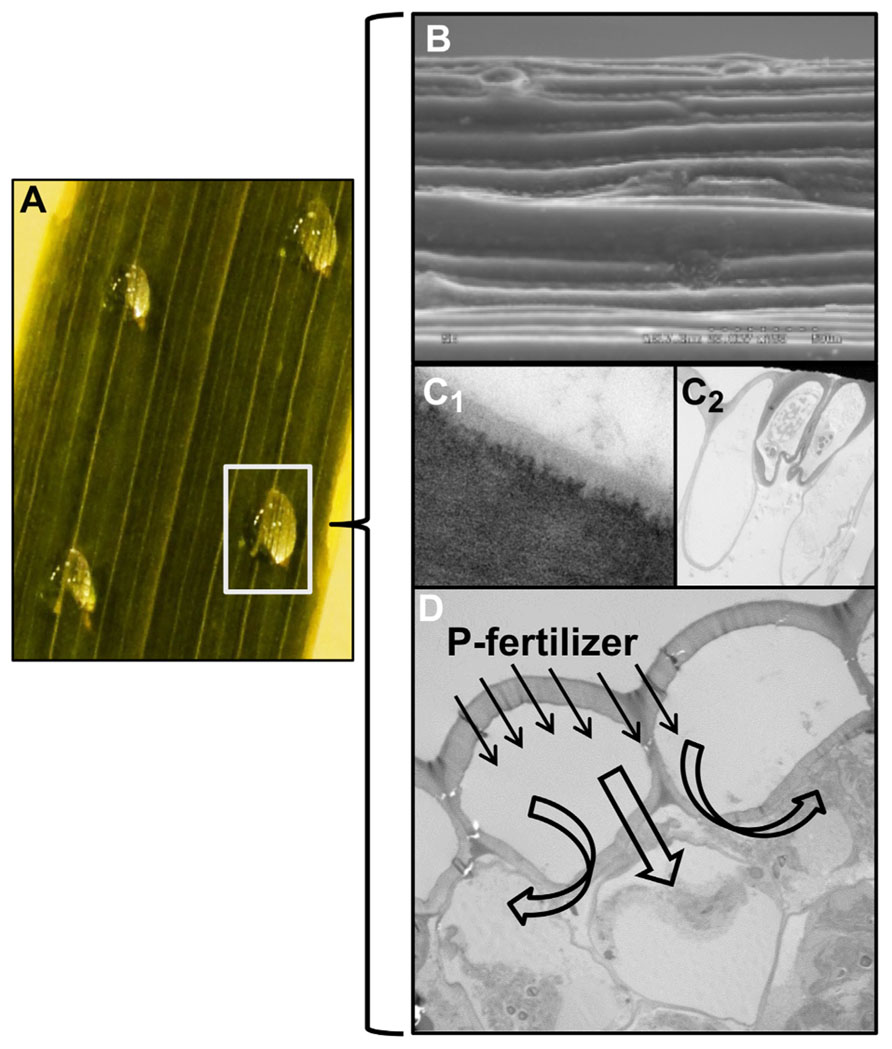
Two distinct pathways exist for substances to cross the cuticle. Lipophilic compounds dissolve into the waxy matrix and diffuse across following a dissolution-diffusion model. Hydrophilic ions and polar nutrients require a completely different route through aqueous pores lined with polar functional groups (2). For most water-soluble fertilizers, this aqueous pore pathway is the only viable option.
Molecular size creates hard limits on penetration
The aqueous pores in plant cuticles impose strict size limitations on what can enter. Research using various ionic compounds has established that average pore radii range from 0.45 to 1.18 nm depending on plant species (1). This means that only very small, water-soluble compounds can squeeze through these tiny channels.
| Parameter | Value | Practical Implication |
|---|---|---|
| Aqueous pore radii | 0.45 to 1.18 nm | Only small ions penetrate efficiently |
| Maximum molecular weight | ~800 g/mol | Large chelates must dissociate first |
| MW 100→500 penetration decrease | 7 to 13× slower | Larger nutrients penetrate much slower |
The relationship between molecular weight and penetration rate follows a clear pattern. Increasing molecular weight from 100 to 500 g/mol decreases rate constants by factors of 7 to 13 (1). The largest molecules demonstrated to pass through cuticular pores had molecular weights around 769 g/mol, establishing an approximate upper limit for ionic penetration.
For lipophilic compounds, size effects are even more pronounced. A fourfold increase in molecular weight results in a greater than 1000-fold decrease in cuticular mobility (2). This explains why small neutral molecules like urea penetrate rapidly while larger molecules move slowly.
However, the molecular weight cutoff is not absolute. Chelates can dissociate at the leaf surface, releasing free metal ions that then penetrate through aqueous pores. Iron-EDTA formulations can still deliver iron to leaf tissue even though the intact chelate is too large to pass through the cuticle.
Electrical charge determines whether nutrients stick or penetrate
The plant cuticle carries a net negative charge due to carboxyl and hydroxyl groups in the cutin matrix (2). Cations are attracted to the negatively charged surface and diffuse passively once contact is made. Anions face electrostatic repulsion and penetrate poorly until internal charge is balanced by cation entry.
| Charge Type | Cuticle Interaction | Penetration Efficiency |
|---|---|---|
| Neutral (urea) | No interaction | Fastest penetration |
| Monovalent cations | Moderate attraction | Good penetration |
| Divalent cations | Strong attraction | Often trapped at surface |
| Anions | Repulsion | Poor initial penetration |
This explains why urea nitrogen penetrates leaves rapidly while ionic forms of most micronutrients struggle. The charge-neutral urea molecule bypasses the electrostatic complications that slow down ionic forms (3).
The situation becomes more complex after nutrients cross the cuticle. The leaf apoplast also carries negative charges that bind cations like zinc, iron, and calcium, limiting translocation (2). As discussed previously, this means foliar micronutrients often remain localized. However, for visible deficiency symptoms, localized correction may be exactly what is needed to maintain crop quality while the root zone issue is corrected.
Surfactants improve uptake but cannot overcome fundamental limits
The primary function of surfactants in foliar applications is reducing surface tension to improve wetting and spreading. Water has a surface tension of approximately 72 mN/m, which surfactants reduce to 25 to 30 mN/m (4). This allows spray droplets to spread across hydrophobic leaf surfaces rather than beading up and rolling off.
Surfactants also directly enhance penetration through the cuticle by increasing rate constants by factors of up to 12 for ionic compounds (2).
Organosilicone surfactants can achieve surface tensions below 25 mN/m, enabling stomatal infiltration (3). This bypasses the cuticle by forcing liquid through stomatal pores. While variable and dependent on stomatal aperture, commercial agriculture uses this approach precisely because when conditions align, the payoff can be substantial.
One study on wheat found that phosphoric acid uptake reached approximately 80% when surfactants were included, compared to only 7 to 27% without surfactant (5). However, high uptake did not guarantee yield benefits. Only one of several treatments tested produced a 12% yield increase, while two treatments actually decreased yield despite similar foliar uptake rates. Yet focusing solely on final yield misses an important point: in hydroponics, visual quality, rapid symptom correction, and preventing irreversible tissue damage often matter more than marginal yield increases measured in field trials. A foliar spray that greens up symptomatic leaves within days may be economically rational even if it adds zero grams to final harvest weight.
Common misunderstandings about foliar nutrition
Many growers apply foliar sprays with expectations that don’t align with the science. The key is understanding foliar nutrition as damage control rather than primary nutrient delivery.
Misunderstanding 1: High uptake guarantees benefit. Even when penetration rates appear impressive (say 80% of applied nutrients crossing into the leaf), this does not translate to plant-wide nutrition. Many nutrients remain localized to treated leaves. Calcium and manganese are particularly immobile after foliar application (2). However, localized uptake is not a failure when the goal is preventing irreversible damage to symptomatic tissue. Greening up chlorotic leaves matters for crop value even if the nutrient never reaches the roots.
Misunderstanding 2: Foliar feeding replaces root nutrition. While foliar nutrition can supplement root uptake, it cannot replace it for macronutrients. The leaf surface area simply cannot absorb the quantities of nitrogen, phosphorus, and potassium required for normal growth. Foliar sprays work best as emergency response tools for visible deficiencies while root zone issues are diagnosed and corrected. This is not a limitation but the intended use case.
Misunderstanding 3: More surfactant means better results. Surfactant concentration requires optimization. Too little provides minimal benefit, but excessive surfactant causes phytotoxicity and leaf scorch that kills the very cells needed to absorb nutrients (5). Some surfactants have even been shown to increase plant disease severity (4).
Misunderstanding 4: Biological inefficiency equals economic irrationality. Foliar sprays may be inefficient biologically but can still be economically rational. When adjusting reservoir composition requires draining tanks or deficiency symptoms threaten late-stage crop quality, a foliar spray costing a few dollars may be worthwhile even if only 10% of nutrients enter the plant. The relevant comparison is cost of application versus cost of delayed harvest or reduced quality.
Environmental conditions during application (humidity, temperature, light), plant developmental stage, and formulation chemistry all interact in complex ways (3). Relative humidity is particularly critical because penetration essentially stops once spray droplets dry on the leaf surface. Applications at 50% humidity may achieve only 1% of the penetration possible at 100% humidity (1). This does not make foliar feeding futile but rather emphasizes the importance of proper timing and environmental conditions for success.
Practical recommendations for hydroponic growers
Treat foliar sprays as emergency correction tools, not primary nutrition delivery systems. As we noted in our previous discussion, timing is critical for optimal results. Applications are best performed during afternoon after temperatures have dropped (usually after 3PM) or early morning when vapor pressure deficit is lower and stomata are more likely to be open.
Focus on small, uncharged molecules when possible. As outlined in our greener foliar spray formulation, urea for nitrogen correction provides superior penetration compared to ionic nitrogen forms. For micronutrient deficiencies, recognize that foliar-applied zinc, iron, and manganese often remain localized to treated leaves. This localization is not necessarily a failure if your goal is preventing damage on currently symptomatic tissue rather than feeding the entire plant.
Always address the root cause. Foliar applications buy time and prevent damage, but cannot substitute for proper root zone nutrition. If you find yourself making repeated foliar applications for the same deficiency, the problem lies in your reservoir composition or growing environment, not in your spray technique.
Have you tested foliar applications in your hydroponic system? What results have you observed? Share your experience in the comments below.