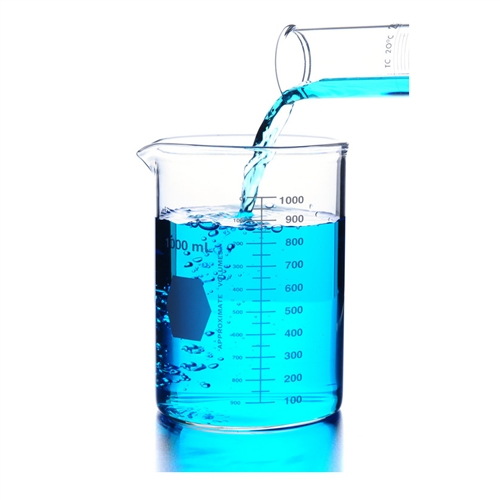
A guide to different pH down options in hydroponics

The control of pH in hydroponic nutrient solutions is important. Plants will tend to increase the pH of solutions in most cases – as nitrate uptake tends to dominate over the uptake of other ions – so most growers will tend to use pH down much more than they use pH up. While most growers prefer to use concentrated strong acids, there are a wide variety of different choices available that can achieve different outcomes at different cost levels. In this post I want to talk about different pH down options in hydroponics, along with some of their advantages and disadvantages.

Hydrangeas change color as a response to different pH values in soil

The first group of pH down chemicals are strong acids. These are technically acids with very low pKa values, meaning they react instantly with water to generate at least one mole of hydronium for each mole of added acid. They offer the strongest ability to drop pH per unit of volume, which makes them more cost effective. However the fact that they often need to be diluted to make the pH addition process practical – because of how much the concentrated forms can change pH – can make their use more difficult than other forms of pH down. These are the most common options:

Phosphoric acid (from 20 to 85% pure): This acid doubles as a plant nutrient, meaning plants will be affected by the phosphorus added. It is commonly used in food – so food grade phosphoric acid can be bought cheaply – it also has additional deprotonations with strong buffering at a pH value of 7.2 with buffering capacity against bases getting stronger as the pH goes down all the way to 6.2. This is the most commonly used acid by hydroponic growers.

Sulfuric acid (from 20 to 98% pure): This acid is commonly used in car batteries and offers the largest pH dropping ability per unit of volume among all the strong acids. It is however important to use food grade sulfuric acid in hydroponics as normal battery acid can include some metallic impurities – from the fabrication process of sulfuric acid – that might negatively affect a hydroponic crop. Food grade sulfuric acid is safe to use in hydroponics. A big advantage is that plants are quite insensitive to sulfate ions – the nutrient provided by sulfuric acid – so adding sulfuric acid does not really affect the nutrient profile being fed to the plants. Note however that most battery acid products in developed countries are also ok, as the quality of these acids demands the metallic impurities (more commonly iron) to be quite low. If in doubt, you can do a lab test of the sulfuric acid to see if any impurities are present.

Nitric acid (from 30-72% pure): This acid also provides nitrate ions to plants, so it also contributes to a solution’s nutrient profile. It is however more expensive than both phosphoric and sulfuric acids and more heavily regulated due to its potential use in the fabrication of explosives. The acid itself is also a strong oxidant, so storage and spillage problems are significantly worse than with phosphoric and sulfuric acid. Although this acid can be used in hydroponics, it is generally not used by most growers due to the above issues.
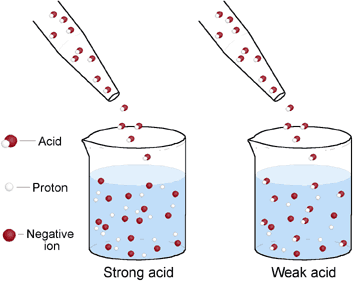
Diagram showing the dissociation of a strong vs a weak acid

The second group of pH down chemicals are weak acids. These are acids that do not generate at least one mole of hydronium ions per mole of acid when put in solution, but do provide a pH down effect as some hydronium ions are generated. This means that larger additions will be needed to cause the same effect but at the same time their handling is usually much safer than for strong acids. Here are some options that could be used as a pH down.

Common food grade organic acids (citric acid, acetic acid, etc): Organic acids are a very low cost way to lower the pH of a hydroponic solution as many of these are available off the shelf in super markets in food grade qualities. The main issue with organic acids – which anyone who has used them has probably experimented – is that the effect of the acids does not seem to hold (pH goes up quickly after the acid is added and the solution comes into contact with plants). This is actually caused by the fact that plants and microbes can actually use the conjugated bases of these ions nutritionally, causing an increase in pH when they do so. The initial addition of say, citric acid, will drop the pH – generating citrate ions in the process – these will then be absorbed by microbes and plants, increasing the pH again rapidly. The use of these acids is therefore not recommended in hydroponics.

Monopotassium phosphate (MKP): This salt contains the first conjugate base of phosphoric acid and is therefore way less acidic than it’s full on acid partner. Since it’s a solid its addition is way easier to control compared to the acid and it can also be handled safely with minimal precautions. It provides both potassium and phosphorous to a solution – both important nutrients – and therefore needs to be used carefully when used as a pH down agent (as it significantly affects the nutrient profile of the solution). Since it adds both a cation that helps counter pH increases by plants and phosphate species it provides a double buffering effect against future pH increases. It is a very common ingredients of commercial pH down solutions for this reason.

Monoammonium phosphate (MAP): Similar to the above, except for the fact that this salt adds nitrogen as ammonium, which is a nitrogen form plants are very sensitive to. Plants will uptake ammonium preferentially over any other cation, so MAP provides a very strong buffering effect against nitrate absorption, with potential problems if too much is used (although this depends on the plant species being grown). When MAP is used as a pH down its addition therefore needs to be carefully controlled in order to avoid excess usage. Due to the presence of this powerful ammonium buffer, MAP is generally very effective at preventing future increases in pH, although this might be at the expense of yields or quality depending on the crop.

Potassium bisulfate: This salt contains the first conjugate base of sulfuric acid and is therefore a powerful tool to decrease the pH of a solution. The resulting sulfate ions provide no chemical buffering effect, so the only buffering effect in terms of plant absorption comes from the addition of potassium ions, which can help mitigate nitrate absorption. This salt is also considerably expensive compared with the two above – which are commonly used fertilizers – and is therefore seldom used in hydroponics.

Which is the best pH down solution? It depends on the characteristics of the growing system. Generally a pH down solution needs to be easy to administer, cheap and provide some increase in buffering capacity overtime – to make additions less frequent – so the pH down product or combination of products that best fits this bill will depend on which of the above characteristics is more important for each particular user.

People who use drain-to-waste systems usually go for stronger acids, since they only adjust pH once before watering and then forget about the solution. This means that additional buffering capacity in the solution is probably not going to be very important and cost is likely the most important driving factor. If injectors are used then the strong acids are often diluted to the concentration that makes the most sense for them and most commonly either phosphoric or sulfuric acids are used.

For growers in recirculating systems options that adjust pH with some added buffering capacity are often preferred, because the same solution is constantly subjected to interactions with the plants. In this case it’s usually preferred to create a mixture of strong and weak buffering agents so that both quick decreases in pH and some increased protection from further increases can be given to the solution. In automated control systems using something like a concentrated MKP solution is preferable over any sort of solution containing phosphoric acid, as issues from control failures are less likely to be catastrophic.

Nutrient solution conductivity estimates in Hydrobuddy

People who use Hydrobuddy can be confused by its conductivity estimates, especially because its values can often mismatch the readings of conductivity meters in real life. This confusion can stem from a lack of understanding of how these values are calculated and the approximations and assumptions that are made in the process. In this post I want to talk about theoretically calculating conductivity, what the meters read and why Hydrobuddy’s estimations can deviate from actual measurements.

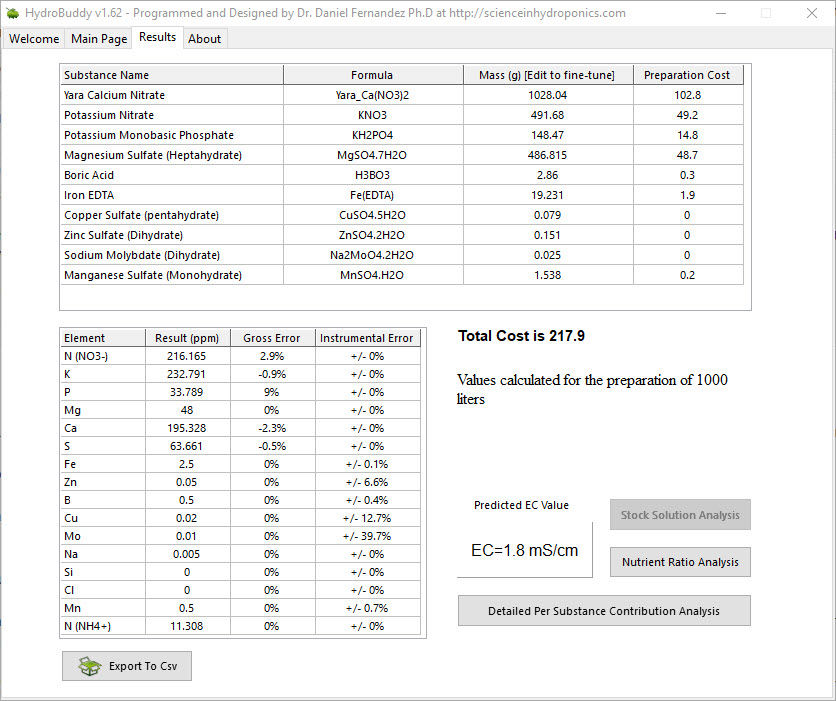
Standard Hoagland solution calculation using HydroBuddy with a set of basic chemicals.

The images above show the use of HydroBuddy for the calculation of a standard Hoagland solution for a 1000L reservoir. The Hoagland solution’s recipe is expressed as a series of elemental concentrations, all of them in parts per million (ppm) units. The results show that the final conductivity of this solution should be 1.8 mS/cm but in reality the conductivity of a freshly prepared full strength Hoagland solution will be closed to 2.5mS/cm. You will notice that HydroBuddy failed to properly calculate this value by an important margin, missing the mark by almost 30%. But how does HydroBuddy calculate this value in the first place?

Conductivity cannot be calculated by using the amount of dissolved solids in terms of mass because charges are transported per ion and not per gram of substance. To perform a conductivity calculation we first need to convert our elemental values to molar quantities and then associate these values with the limiting molar conductivity of each ion, because each ion can transport charge differently (you can find the values HydroBuddy uses in the table available in this article). This basically means we’re finding out how many ions we have of each kind and multiplying that amount by the amount each ion can usually transport if it were by itself in solution. The sum is the first estimate in the calculation of conductivity.

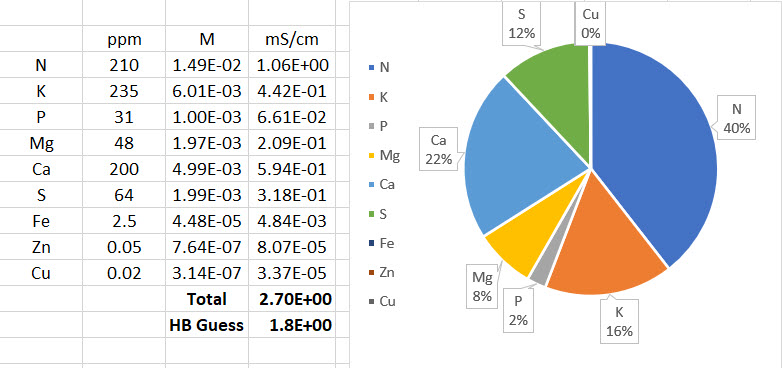
Conductivity calculations carried out by HydroBuddy, also showing conductivity contributions per ion. This is done by converting ppm quantities to moles, then multiplying by limiting molar conductivity values here.

The image above shows the result of these calculations for an example with a perfectly prepared Hoagland solution. You can see that the estimate from limiting molar conductivity is initially 2.7 ms/cm – much closer to the expected 2.5 mS/cm – but then HydroBuddy makes an additional adjustment that lowers this down to 1.8 mS/cm. This is done because limiting molar conductivity values make the assumption of infinite dilution – what the ion conducts if it were all by itself in solution – but in reality the presence of other ions can decrease the actual conductivity things have in solution. HydroBuddy accounts for this very bluntly, by multiplying the result by 0.66, in effect assuming that the measured value of conductivity will be 66% of the value calculated from the limiting molar conductivity values. This is of course wrong in many cases, because the reduction in activity due to the presence of other ions is not as strong. However it can also be correct in many cases, primarily depending on the substances that are used to prepare the formulations and the ratios between the different nutrients.

In my experience HydroBuddy tends to heavily underestimate the conductivity of solutions that receive most of their conductivity from nitrates, as this example, but it tends to do much better when there are large contributions from sulfate ions. When I first coded HydroBuddy all my experiments were being done with much more sulfate heavy solutions, so the correction parameter value I ended up using for the program ended up being a bad compromise for solutions that deviated significantly from this composition. With enough data it might be possible to come up with a more advanced solution to conductivity estimations in the future that can adjust for non-linear relationships in the conductivity and activity relationships of different ions in solution.

If your measured conductivity deviates from the conductivity calculated in HydroBuddy you should not worry about it, as HydroBuddy’s values is meant to be only a rough estimate to give you an idea of what the conductivity might be like but, because of its simplicity, cannot provide a more accurate value at the moment. The most important thing is to ensure that all the salts, weights and volumes were adequately measured in order to arrive at the desired solution.


Sugars in hydroponic nutrient solutions

Carbohydrates are an integral part of plants. They produce them from carbon dioxide, requiring no additional external carbon inputs for the process. However, since plants can absorb molecules through their leaves and roots, it is perhaps natural to wonder whether they could also get carbohydrates through the roots and avoid some of the stress they go through in order to produce these molecules from scratch. If plants can uptake sugar and we feed them sugars then will we get fruits with more sugars and bigger plants? It’s an interesting question that I will try to answer within this post, looking at the potential use of simple sugars within hydroponic nutrient solutions.

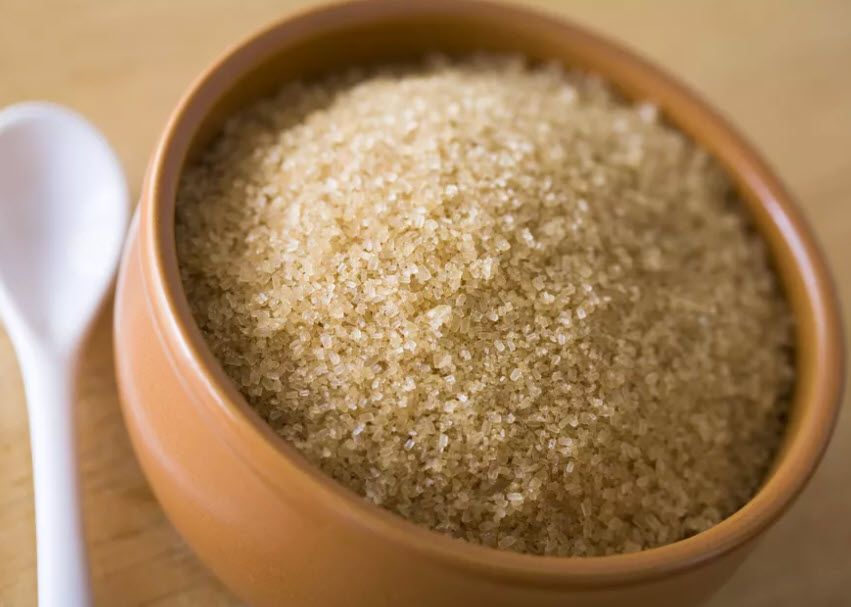
Simple table sucrose

Although the above idea sounds straightforward, it hardly has any interest in the scientific literature or the commercial hydroponic industry. You will find no significant number of research papers studying the use of sugars – simple or complex – in hydroponic nutrient solutions and very few studies looking at sugar uptake and the interactions of in-vitro plant tissue with simple sugars. This lack of interest and use is no accident, it comes from an already established understanding of plant physiology and the realization that it is not cost effective, useful or needed to add sugars to nutrient solutions.

Let us start with what we know about the subject. We know that plants exude very significant amount of sugars through their root systems and we also know that they can re-uptake some of these sugars through their roots (see here). From this paper it seems that maize plants could uptake up to 10% of the sugars they exude back into their root systems, which implies that some exogenous sugar application could find its way into plant roots. Even worse, transporting this sugar up to the shoots is extremely inefficient, with only 0.6% of the sugar making it up the plant. This tells us that most of the sugar is wasted in terms of plant usage, a large majority never makes it into the plant and the little amount that makes it actually never goes up the plant. Plants are simply not built to transport sugars in this manner, they evolved to transport sugars down to roots and to fruits.

But what about the roots? Given that the plant tissue that would be in direct contact with the sugar is the roots, it is logical to think about positive effects affecting them primarily. We have some studies about the influence of sugar solutions in seedlings (like this one) which does show that sugars can stimulate the growth of new root tissue in very small plants. However in large plants most of the sugar content in the roots will come from transport from the higher parts of the plant and the local sugar concentration will be low. Seedlings can likely benefit from sugars in the roots because leaves are producing very little at this time but larger plants are unlikely to benefit from this effect.

There is however one effect that sugars have that is very clear, they feed the rhizosphere around the plant’s roots. Although plants try to care about this themselves – by exuding an important amount of sugars and organic acids – an exogenous sugar addition would most likely boost the amount of microbes around plant roots (both good and bad ones). The profile of sugars and acids exuded by plants is most likely tuned by evolution to match the microbes that are most beneficial to it and an unintended and negative effect of sugars is to boost all microbe populations at the same time, regardless of whether they are good or bad for the plant. This also increases oxygen demand around roots – because aerobic microbes will want to oxidize these sugars – reducing the amount of oxygen available to plant roots. For this reason, any application of a sugar to a nutrient solution requires the inoculation of the desired microbes beforehand, to ensure no bad actors take hold. It also requires the use of a media with very high aeration, to prevent problems caused by oxygen deprivation.

Sadly there aren’t any peer reviewed papers – at least that I could find – investigating the effect of exogenous sugars on the yields of any plant specie in a hydroponic environment. Given our understanding of plant physiology, any positive effects related with anecdotal use of sugars are most likely related with positive effects in the rhizosphere that are linked with improved production of substances that elicit plant growth in the root zone by favorable microbes. This is mainly because it is already well established that transport of sugars within plants from the roots to the shoots is incredibly inefficient, so any contribution of the roots to sugar uptake will be completely dwarfed by the actual production of sugars from carbon dioxide in the upper parts of the plant. It is not surprising that no one seems to want to do a peer reviewed study of a phenomenon whose outcome is already largely predictable from the accepted scientific literature.

If you’re interested in the use of sugars in hydroponics, it is probably more fruitful to focus on microbe inoculations instead. Sugars themselves are bound to provide no benefit if they are not coupled with a proper microbe population and, even then, you might actually have all the benefits without any sugar applications as the microbes can be selected and fed by plant root exudates themselves in mature plants although sugars might provide some benefits in jump starting these populations, particularly in younger plants. Also, bear in mind that there is also a very high risk of stimulating bad microbes with the use of sugars, especially if oxygenation is not very high.


Maximizing essential oil yields: A look into nutrient concentrations

Essential oils are the main reason why several plant species are currently cultivated. These oils have a wide variety of uses either in the food industry or as precursors to more complex products in the chemical industry. Modifying nutrient solutions to maximize oil yields in hydroponic setups is therefore an important task. However, there are sadly no clear guidelines about how this can be achieved. In today’s post I wanted to create a small literature review of different research papers that have been published around the modification of nutrient solutions to maximize essential oil production and see if we can draw some conclusions that should apply to plants that produce them.

The variety of plants that produce essential oils is nothing but amazing. From plants where mainly the leaves are harvested – such as mint and basil – to plants where the flowers are used – such as roses – to plants where the seeds are used, like coriander. The wide variety of oil sources and plant species implies that the universe of potential research is immense, with every potential nutrient modification in every plant giving a potentially different optimal measurement. However, plants share some important characteristics – like photosynthesis and root absorption of nutrients – plus essential oils within different plants can share components produced using similar chemical pathways. For this reason, a look into the research universe of nutrient solution optimization for essential oil production is likely to serve as a base to guide us in the optimization of a solution for a particular plant.

Plant Optimal (ppm) Link to reference
Mint 195-225 N , 178-218 K https://www.actahort.org/books/853/853_18.htm
Sweet Basil 180 Ca https://www.cabdirect.org/cabdirect/abstract/20013048426
Costmary 200 N, 200 K https://pubag.nal.usda.gov/catalog/732179
Mint <= 276 K http://www.scielo.br/scielo.php?pid=s0103-84782007000400006&script=sci_arttext
Chrysanthemum 159 Ca https://pdfs.semanticscholar.org/13ea/999605458e65d9023dadbabca48464a5fa70.pdf
Chrysanthemum 43 N (NH4) https://tinyurl.com/vqupwvf
Lavender 300 K https://scielo.conicyt.cl/scielo.php?pid=S0718-95162017005000023&script=sci_arttext&tlng=en
Rose Geranium 207 K http://ir.cut.ac.za/handle/11462/189
Rose Geranium 110 S, >= 68 P https://www.tandfonline.com/doi/full/10.1080/02571862.2012.744108
Spearmint 200 N https://www.sciencedirect.com/science/article/abs/pii/S2214786117300633
Lavender 200 N, 50 P https://www.sciencedirect.com/science/article/abs/pii/S0926669015306567
Mint 414 K https://sistemas.uft.edu.br/periodicos/index.php/JBB/article/view/601
Spearmint 50-70 P https://www.sciencedirect.com/science/article/pii/S0308814618317862
Marjoram >= 36 Mg https://www.actahort.org/books/548/548_57.htm
Salvia 150 N https://pubs.acs.org/doi/abs/10.1021/jf030308k
Dill 300 N https://www.actahort.org/books/936/936_22.htm
Summary of different papers addressing essential oil yield optimization in hydroponic setups by varying one or several nutrient concentration values.

In the table above I summarize the research I found concerning the optimization of some mineral nutrient in the hydroponic production of a plant, specifically to maximize the essential oil yield. All of these studies optimized the nutrient within a given range and a >= or <= sign is used whenever the optimal value found is at the top or bottom of the range respectively. When more than one nutrient was optimized in the paper, I give you the values for both nutrients so that you can glimpse the optimal. Whenever the researchers suggest an optimal range instead of a value within their research this is also included as a range. I tried to find papers representing all macro nutrients but studies optimizing some elements were hard to find (Mg for example). Although I tried to include as many species as possible some species are just more commonly studied, as they are commercially more relevant (like mint and basil).

From these research results we can immediately see some clear trends. From all the studies there is no result where optimal total nitrogen concentration is below 150 ppm and 3 out of the 4 studies I found, agree that the optimal N concentration is at 200 ppm. In the case of K all studies agree that K should be at least 200 ppm, but I did find a study on mint that got a value of 414 ppm, far larger than the value found in other studies for the same specie. This is not an uncommon discrepancy in hydroponics – optimal yields being mixed in a wide range above 200 ppm of K – which can be caused by other issues that can affect K absorption, such as the concentration of other important cations (like Ca and Mg) in the studies.

I was only able to find two studies that focused on Ca and both agree about optimal values between 150 and 180 ppm, although they address two completely different plant species (basil and chrysanthemum). In the case of Mg I found only one study and its conclusion was mainly that you want to have more than 36 ppm of Mg in solution. This is not surprising as Mg is rarely a growth limiting element in hydroponics and usually growth will not be limited to it unless its supply is very low compared to the supply of other nutrients (which is very rarely the case).

In the case of P, it’s not surprising that most papers that addressed this nutrient studied plants where the essential oils are mainly in the flowers (rose and lavender), as phosphorous is a nutrient commonly associated with flowering. In the case of rose the best value in the study was sadly the upper limit and in the case of lavender the optimal value reached was 50 ppm. In this case we can therefore probably only say that both studies share having an optimal result of >= 50 ppm but it’s hard to provide an upper bound for this. A study addressing P in spearmint also finds optimal P to be within exactly this range at 50-70 ppm.

Element ppm
N 200
P 60
K 200
Ca 160
Mg 45
A base “guess’ formulation for a plant producing essential oils

With these results in mind, we can sketch a base solution for a plant where essential oil production is being targeted.. An obvious guess would be to start with a solution with the concentration profile showed above. In this case we target N and K at 200 with an N:K ratio of 1 and we keep Ca at 160, making the K:Ca 1.25 (which is surprisingly close to the optimal value discussed in my Ca post). We leave P at 60 – the middle of the 50-70 range – and we keep Mg at 45, which is > 38 and is a value commonly used in regular hydroponic solutions. The above will certainly not be the best solution for any single plant a priori, but it might provide a good base to start optimizing from if the objective is essential oil production.


The media exchange solution test: A better measurement of media effects in hydroponics

In the traditional hydroponic paradigm we want media to be as chemically inert as possible. The ideal media in this view would absorb no nutrients, give off no nutrients and would not decompose or react with the nutrient solution in any way. However none of the commonly available media sources comply with these properties, reason why we must be vigilant and properly adjust the media we use to fit the needs of our hydroponic setup. In this article I am going to talk about the idea of using a direct comparison test of the nutrient solution against the media, to understand the effect the media will have when exposed to the target nutrients and how this can help us adjust our solutions to better play with the selected growing medium.

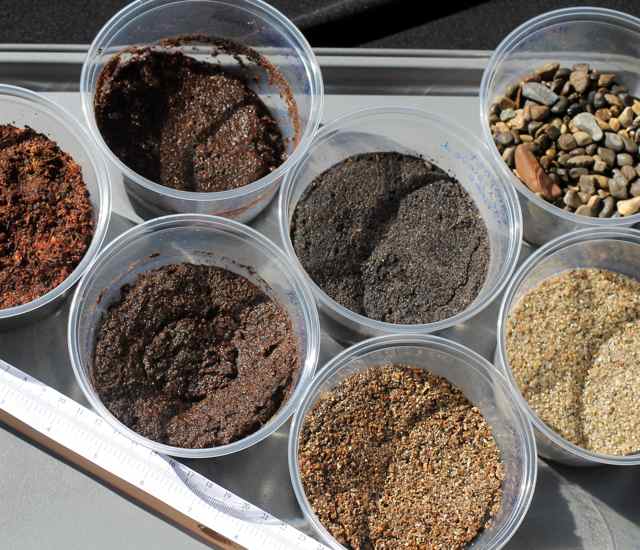
Different types of growing media

First, let us understand how the media interacts with a hydroponic solution. The media can do all of the following things:

  • Dissolve into the solution (this is what happens if your media is something like sand or limestone). In this case the media is chemically reacting with the nutrient solution, therefore media is being irreversibly lost in the process. This can happen very fast, with something like limestone, or very slowly, with something like sand.
  • React and take something away from the solution. In this case the media can use ions within the solution to perform reactions that create new substances that are insoluble. For example if you have media containing large amounts of rock phosphate this phosphate can cause the precipitation of heavy metal phosphates.
  • Release ions in exchangeable locations into the media. This is different than dissolving because the media is not getting destroyed in the process but it is emptying “storage sites” that contain some ions that prefer the solution instead of these sites. This process is fundamentally reversible and – under the proper conditions – these sites could be replenished with the same or different ions.
  • Take ions into exchangeable locations in the media. This is the opposite of the process above. In this case the media will receive some ions into “storage sites” because these ions prefer the media to the hydroponic solution. The solution will therefore be depleted of these ions because they are being stored within the media.

Of most interest to us are the third and fourth points above, this is generally understood as the “exchange capacity” of the media. This determines how many and which nutrients the media can store. Different media can have storage sites with different affinities and in hydroponic setups we generally want to aim for the minimum energy state of these storage sites as they relate to our nutrient solution. Media that is already in equilibrium with the nutrient solution will tend not to change it while media that is far away from equilibrium with the solution will change it strongly towards the equilibrium point.

Think about coco coir, a commonly used media in hydroponics that can have a wide variety of different ion exchange capacity values and a lot of different ions initially in its “storage sites” due to the differences in sourcing materials and treatments done by different companies. Coco coir initially contains high amounts of potassium and sodium ions, but some companies treat it with Ca nitrate, which changes all these “storage sites” to contain Ca instead. These two sources of coco would interact very differently with our nutrient solution. In the first case the coir would exchange a lot of its potassium for Ca and Mg ions in solution – because these ions have higher affinity for the “storage sites” – while in the second case a little Ca would be exchanged for other ions (because all ions are in equilibrium with all the storage sites). The changes to the solution are very different and totally different approaches in nutrient composition changes are required.

Traditional soil tests could provide some answer to us, they would definitely show the ions that could be exchanged to be different in both cases. But they tell us little about the equilibrium position of the media against our target nutrient solution. To make things more realistic we can actually do a test where we pass our actual nutrient solution through a column of media that is exactly what we’re going to run it through in real life (with no plants of course). We then collect the input and output solution and run lab analysis of both of these solutions. We can then compare the results and see how much the media is actually changing the composition of our input solution and we can then make some decision to adjust. Such a test would proceed as follows:

  1. Prepare the strongest final solution that will be used in the growing process. (for example the solution that is used at the peak of fruit generation in a tomato crop)
  2. Take a sample of this starting solution to send for chemical analysis.
  3. Pack a burette with a column of media as high as the containers the plants will be in.
  4. Fill the burette with the nutrient solution.
  5. Run as much solution as required to collect a sample of equal volume to the first one.
  6. Send both samples for analysis.

The difference in nutrients between both solution will show us what we should initially be doing to maintain a consistent composition of the nutrient solution, given the interaction with the media. If the interaction is too strong it can also tell us that we shouldn’t be using this media without previously treating it to ensure the imbalances do not happen. For example media like biochar can have an extremely high affinity for metal chelates and nitrogen compounds, if we ran our solution through the media and it turns out that it soaked up almost all of our iron and ammonium, we wouldn’t want to just add more nitrate and heavy metals but we would like to pretreat the media with a concentrated solution and then repeat the test to ensure that the media is at a level of activity that we can correct for.

A given media source that is acceptable should not strongly affect the nutrient solution. Any media that does this in the media exchange test requires correction so that the ability to take elements from the nutrient solution is reduced. The test will tell you exactly what the media is finding most appetizing and the treatment options will then be substantially easier to plan. A coco coir that shows it soaks up almost all the Ca will need to be treated with a Ca nitrate solution and a biochar that absorbs a lot of ammonium will need to be treated with an ammonium sulfate solution. These are some cheap pretreatments that will save a lot of heartache within a hydroponic setup and will make the ongoing growing process substantially easier to manage.

This is one of the simplest and cheapest tests that can be done to address media effects. However it is by no means comprehensive in that it does not show us other important media properties that might be crucial for selection. It is important to consider that this test gives us only a glimpse of the chemical properties and the interactions with the actual nutrient solution we intend to use. Other media specific analysis and more complicated media run-off tests can be necessary to address the full extent of the interactions through an entire crop cycle.


Five things you should know when mixing your own hydroponic liquid nutrients

Many hydroponic growers – especially large scale ones – can benefit greatly from mixing their own custom nutrients. Not only can this save money in the thousands of dollars per month but it can also give you an unprecedented degree of control when compared with store-bought nutrients. On today’s post I am going to write about five important things you should know when mixing your own nutrients so you can avoid many common problems that can arise when you start preparing your own stock solutions.

More concentrated solutions are not always better. When you prepare a concentrated liquid you would usually want to go with the highest possible concentration factor so that you can prepare as much final nutrient solution as possible with as little stock solution as possible. However trying to get into higher concentration factors (1:400-1:500) can cause important issues due to the solubility of the salts used and the temperatures the stock solution will be exposed to. It can also cause high inaccuracies with variable injector setups since the dilutions will be much smaller. For starters go with a 1:100 concentration factor and only start going higher when you get more experience. If you’re using injectors I would generally avoid a range higher than 1:250 unless you do more extensive calibration procedures with your injectors.

Impurities can cause important problems. Some salts can come with significant levels of impurities – sometimes mainly additives – that can cause substantial issues when preparing your nutrient solutions. Lower quality grade salts – mainly those used for soil fertilization or those that are OMRI listed and come straight from mining with no refining – can generate problems within your mixing process. These problems range from insoluble left-overs in tanks to toxic amounts of some micro elements. To ensure you get the best possible results use greenhouse grade fertilizer salts and try to avoid sources of salts that are OMRI listed. Synthetic sources that have been heavily purified are your best bet in ensuring the best possible results.

Use slightly acidic deionized water to prepare the solutions. Most water sources in Europe and the US are very heavy in carbonates an therefore inappropriate for the preparation of concentrated nutrient solutions as these ions can cause salts to precipitate when preparing concentrated solutions. To fix this issue the best thing would be to use distilled water but – since this is often not an option – the next best thing is to use reverse osmosis water and add a bit of acid (0.5mL/L of nitric acid, other acids may cause other problems) per gallon of concentrated solution. This will ensure that everything gets dissolved and will eliminate the carbonates that can be naturally present within the water. Of course never, ever use tap or well water to prepare concentrated hydroponic solutions.

Salts take up volume, take that into account. A very common mistake when preparing solutions is to just add the salts to the final volume of desired stock solution to prepare. This is a mistake since the salts also take up volume. If you want to prepare 1 liter of concentrated solution and you need to add say, 100 g of potassium nitrate,  adding 100g of potassium nitrate to 1L of water would generate a solution with a final volume greater than 1L. To avoid this problem always add the salts to half the volume of water and, after the salts have dissolved, complete to the final volume of desired solution.

Add salts from the smallest to the largest quantities. When you prepare hydroponic solutions it is often better – especially when you’re starting – to add salts from the smallest to the highest amounts needed. If you make a mistake at some point then you will minimize the amount of mass of salts that has been wasted due to this fact. If you make a mistake adding a micro nutrient you will only lose a small amount of the other micro nutrients instead of losing a huge amounts of macro nutrients due your order of addition. It is also true that the substances that are added in largest quantities are commonly  nitrates and these salts have endothermic dissolutions – meaning they cool solutions upon addition – so it is better to add them last so that they can benefit a bit from the heat generated by the dissolution of the other salts.

The above is not an exhaustive list of pointers but it should save you from some important trouble when preparing your own initial nutrient solutions.Although some of these points may seem obvious to those that have experience preparing their own solutions they may prove invaluable to those who are just starting their journey in concentrated nutrient preparation.